
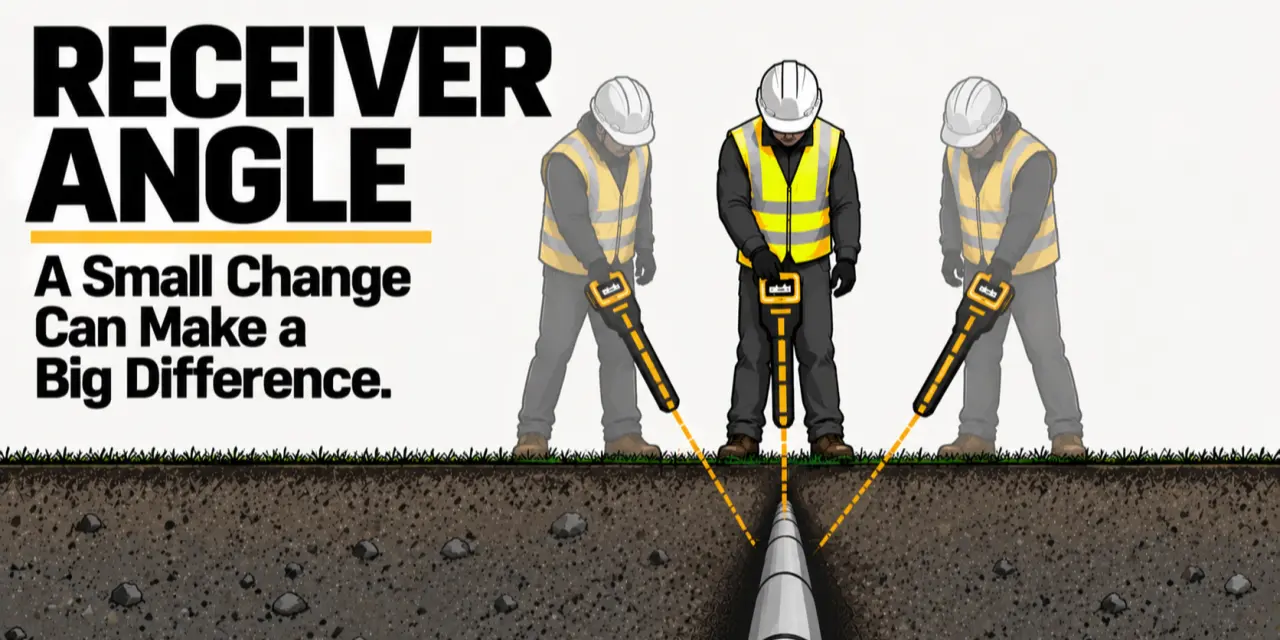
Series: Receiver Angle Control: Getting Consistent Sweeps
by Allan Williams, Training Development Manager | GeoPoint Academy
A receiver is designed to be held vertical. Once you start leaning it during a sweep, you can change the information you are getting.
A receiver is designed to be held vertical. Once you start leaning it during a sweep, you can change the information you are getting.
Sweeping from side to side is a normal part of locating. We use that movement to watch the response build, find the center, and see how it falls away on either side.
How wide the sweep needs to be depends on the locate. Sometimes it may only be a couple of feet. Other times you may need to move three or four feet, or even farther.
You can cover as much ground as you need to. Just keep an eye on what the receiver is doing while you move.
Keep It Vertical
A receiver is built around a specific antenna arrangement. Those antennas are designed to interact with the electromagnetic field in a particular orientation.
When the receiver is upright, the antennas are positioned the way the equipment is designed to use them.
As you move left and right, the whole receiver should move with you while staying as vertical as practical.
Problems can show up when that side-to-side movement turns into more of a pendulum motion.
The technician's hand stays fairly close to the same place while the bottom of the receiver swings from side to side. As the receiver moves left, it leans one way. As it moves through center and toward the right, the angle reverses.
Now the receiver is changing position and angle at the same time.
That can change what you see on the screen.
Your Technique Can Change Where You Mark
The bigger concern is what can happen when the receiver is allowed to tilt during the sweep.
As the bottom of the receiver moves to one side, the receiver may lean back toward the conductor. It can still respond to the signal even though the bottom of the receiver is no longer directly over the conductor.
That is where a locating error can happen.
If the technician sees a strong response and treats the position of the receiver as the center of the utility, the mark can end up offset from the actual conductor.
The farther the receiver is allowed to lean, the greater that separation can become.
This is why I want the receiver kept vertical throughout the sweep.
Move it side to side. Let the response build as you approach the conductor and fall away as you move past it. If you need a wider sweep, move your feet and take the receiver with you.
Once you identify the center of the response, the receiver should already be vertical and positioned over the point you intend to mark.
That keeps the surface mark tied to the location of the conductor instead of the angle of the receiver.
Repeatability
When I cross the same conductor several times under similar conditions, I want the response to look reasonably consistent.
That consistency gives me something to work with.
If the response changes, I want to be able to look for a reason in the locate. Maybe the conductor changed direction. Maybe another utility is influencing the signal. Maybe the field is becoming distorted.
If the receiver angle is changing during every sweep, those changes become harder to sort out.
Keeping the receiver vertical removes one variable we can control.
Depth and Current Need Good Technique Too
Depth and current readings come from measurements of the electromagnetic field the receiver is detecting.
Receiver position can affect those measurements.
If the antenna orientation changes, the information being used to calculate depth or current can change with it.
I do not want a technician leaning the receiver over and then immediately trusting the depth reading on the screen.
Get the receiver positioned correctly first. Keep it vertical. Then look at the information.
Depth and current are part of the locate, and the way the receiver is being held is part of that measurement.
Maybe “Swing” Gives the Wrong Picture
We use the phrase "swing the receiver" all the time.
I've been know to use it too.
But I sometimes wonder what a new technician pictures when they hear it.
Swing can sound like pivoting the receiver from the wrist or elbow, which can easily turn the movement into an arc.
What I want to see is simple side-to-side movement.
Move the whole receiver left.
Keep it upright.
Cross the response.
Move it back the other way.
Keep it upright.
If you need to cover three or four feet, cover three or four feet.
If you find yourself reaching so far that the receiver starts leaning, move your feet. Reposition yourself and continue the sweep.
The receiver should travel through the field while staying as upright as practical.
This Is Where Training Comes In
This may look like a small technique, but these are the kinds of habits that can get missed when training focuses mostly on buttons, arrows, and numbers.
It is easy to tell someone:
"Swing the receiver."
"Follow the response."
"Find the strongest point."
It takes a little more time to help a technician understand how their own movement can influence what they see on the screen and, ultimately, where they put the mark.
The angle of the receiver, its height above the ground, body position, and the motion of the sweep can all affect the consistency of the response.
Once a technician understands that, they are more likely to look at their own technique when something does not make sense.
That is where they start moving beyond simply operating the equipment and begin interpreting what the receiver is telling them.
Control the Variables You Can
Utility locating already gives us plenty to work through.
- Congestion
- Parallel conductors
- Grounding conditions
- Signal transfer
- Distortion
- Nearby electrical sources
Field conditions are not always going to cooperate.
How we hold the receiver is something we can control.
Keep it upright. Move it through the field. Try to make each sweep as consistent as the last.
When something on the screen changes, you want to have confidence that the change is coming from the locate.
And sometimes, before looking underground for an explanation, it is worth taking a quick look at how the receiver is being held.