
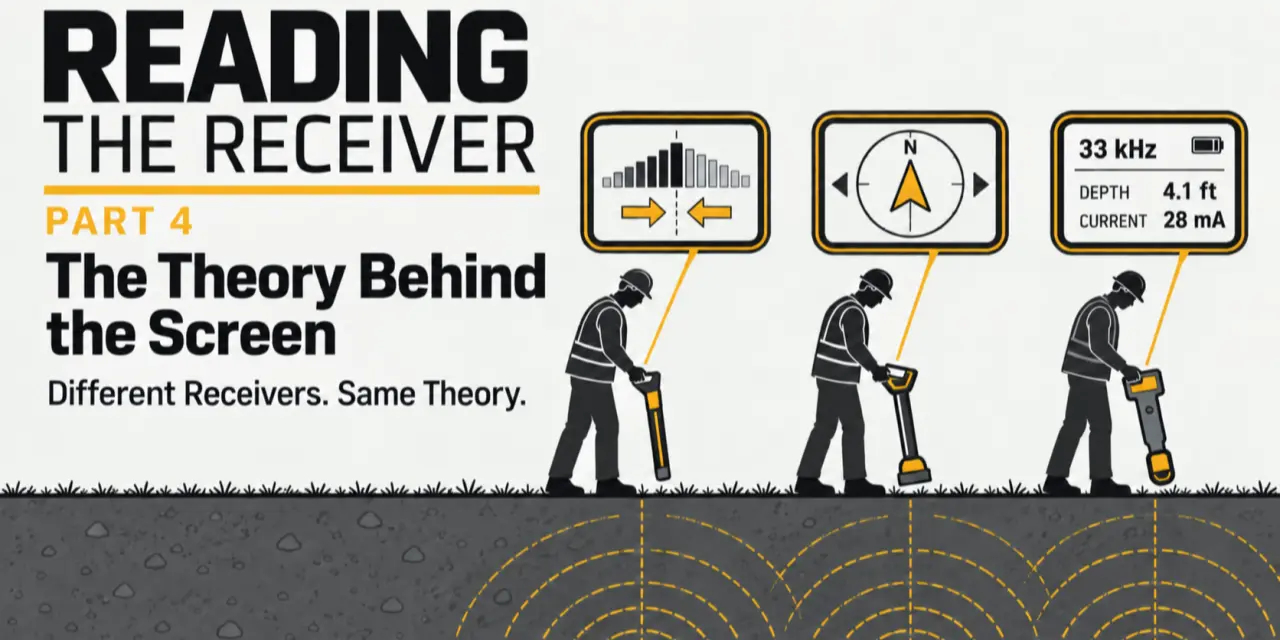
Series: Reading the Receiver: The Theory Behind the Screen
by Allan Williams, Training Development Manager | GeoPoint Academy
The receiver can change. The screen can change. The terminology can change. The electromagnetic field you’re trying to understand is still there. In Part 3, we looked at some of the information a utility receiver can put in front of a technician, including signal strength, frequency, depth, current, and gain.
The receiver can change. The screen can change. The terminology can change. The electromagnetic field you’re trying to understand is still there. In Part 3, we looked at some of the information a utility receiver can put in front of a technician, including signal strength, frequency, depth, current, and gain.
Hand an experienced technician a receiver they’ve never used before and, for a moment, even familiar work can feel unfamiliar.
The buttons are in different places. The terminology may change. The display looks different. Information that used to appear in one part of the screen may be somewhere else, or presented in a completely different way.
But the locating theory the technician has learned still goes with them.
That is one of the reasons I believe theory is such an important part of utility locating training.
Not theory for the sake of theory.
A new locator doesn’t need to spend the first day buried in electromagnetic formulas or terminology they may not understand yet. But they do need enough understanding of the principles behind locating to know why their equipment responds the way it does.
That knowledge becomes increasingly important as their experience grows.
Learning the Receiver
There is real value in becoming comfortable with the receiver you use every day.
After enough time, operating it becomes almost automatic. You know the controls. You know where information appears. You recognize the normal behavior of the display.
That familiarity helps a technician work efficiently.
Eventually, though, equipment changes.
A company may purchase a different brand. A technician may change employers. A regular receiver may be unavailable and another model gets pulled from the truck.
Suddenly, some of those familiar visual cues disappear.
The technician still has locating knowledge to work from.
Receiver orientation still matters.
The path of the conductor still matters.
The electromagnetic field still responds to surrounding conductors and other influences.
Frequency selection still matters.
Signal application still matters.
Distortion still matters.
Those things aren't tied to one manufacturer.
Where Theory Becomes Practical
When I talk about theory in locator training, I'm not talking about making every technician an expert in electromagnetic physics.
I'm talking about understanding enough to explain what is happening in the field.
- Why does the receiver give its strongest response in a particular position?
- Why can nearby conductors change the response?
- Why can a signal transfer onto something the technician wasn't intending to locate?
- Why does receiver orientation affect the information being displayed?
- Why should an unexpected change in the response get the technician's attention?
Those questions are important because eventually every locator encounters something that doesn't behave exactly the way the training example did.
That's when simply knowing which button to push isn't enough. The technician has to think about what could be happening.
Different Equipment, Familiar Principles
There are a lot of good utility locating receivers in use today.
Radiodetection, Vivax-Metrotech, Subsite, Schonstedt and other manufacturers have developed different ways of helping technicians interpret the electromagnetic field.
Some receivers put a lot of information on the screen.
Others keep the display relatively simple.
The terminology can differ. Signal strength may be expressed differently. Directional information may be presented differently. One receiver may provide information that another model doesn't display at all.
A technician still needs training on the particular receiver they are using. Manufacturer procedures, controls and operating modes matter. But understanding the theory gives the technician a starting point.
Instead of asking only, "Where is the feature I used on my old receiver?" they can begin asking, "How is this receiver showing me the information I need?"
That's a much more useful question.
Training Has to Build Understanding
This is also why I think locator training has to go above and beyond equipment operation.
Teaching someone how to turn on a receiver, select a frequency and follow a display is only part of the job.
The technician should understand enough about the underlying theory to recognize when the information they are seeing makes sense and when it deserves a closer look.
That understanding doesn't have to happen all at once. In fact, I don't think it should.
There is a lot for a new locator to absorb. Good training should give them a foundation they can actually use, then continue building on it as they gain field experience.
The theory becomes much more meaningful when the technician begins seeing it happen in real situations.
A parallel conductor is no longer just something shown on a diagram.
Distortion isn't just a definition.
A change in current, signal response or direction becomes something the technician has actually experienced.
That's where classroom knowledge and field experience begin working together.
What the Technician Takes With Them
Equipment will continue to change.
Displays will improve. Manufacturers will add new features. Some functions will become easier to use, and receivers will continue giving technicians more information about what is happening underground.
That's a good thing.
But the most useful piece of equipment still needs someone who understands what they are looking at.
Over this series, we've talked about Peak and Null, directional information, and some of the numbers that appear on receiver screens.
While those features are important, the bigger lesson is understanding enough about locating theory to make sense of the information when conditions aren't perfect, when something changes, or when a different receiver ends up in your hands.
That is something a technician can carry from one piece of equipment to the next.
And it's one of the reasons I believe a solid foundation in locating theory belongs at the center of good locator training.
The receiver may change throughout a technician's career. The understanding they build can continue growing with them.