
Building a Field-Ready Utility Locating Workforce
What it takes to develop safer, more confident, and more consistent crews
Utility locating requires more than learning how to operate a transmitter and receiver. Locators need to understand signal behavior, know which locating method is appropriate, recognize when a signal may be misleading, troubleshoot poor responses, and make good decisions in changing field conditions.
Building those skills takes a consistent training process that combines technical knowledge, hands-on practice, field experience, and continued coaching.
A Consistent Training Foundation
Locators come into training with different levels of experience. Some may be completely new to utility locating, while others may already have field experience from another company or utility.
A consistent training program gives everyone the same foundation in the areas that matter most, including:
- Utility locating theory and signal behavior
- Proper transmitter and receiver operation
- Direct connection, clamp induction, and induction
- Frequency selection
- Recognition of distorted or misleading signals
- Troubleshooting
- Safety and damage-prevention practices
- Documentation and communication
- Field procedures and performance expectations
This also gives supervisors a clear starting point when evaluating and coaching technicians in the field.
Practical Training and Field Application
Utility locating is a hands-on profession. Technicians need time with the equipment and opportunities to apply what they have learned.
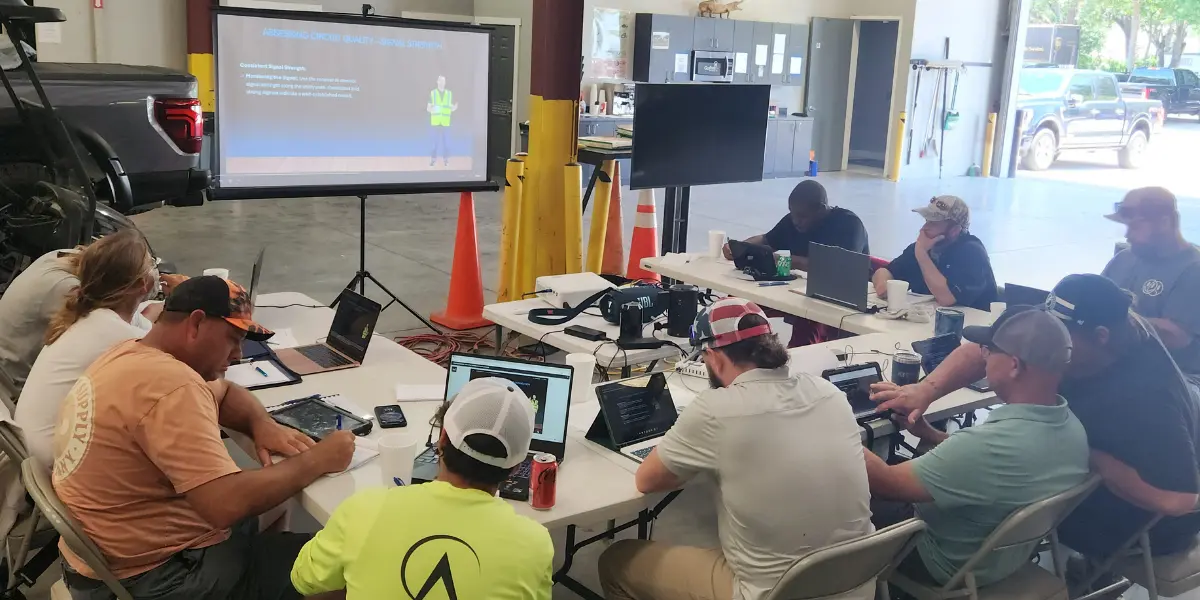
Practical training may include equipment demonstrations, simulator exercises, locating scenarios, troubleshooting exercises, and field instruction.
Simulator training can be useful for practicing receiver handling, centering over a signal, gain adjustment, signal interpretation, and other basic locating techniques. It also allows instructors to observe how a learner is using the receiver and correct problems before those habits carry into the field.
Field training adds another level of experience. Real job site conditions can include congested utilities, poor grounding conditions, interference, limited access to conductors, changing soil conditions, and signals that do not behave as expected.
Working through those conditions with an experienced instructor helps technicians learn how to evaluate what they are seeing and decide what to do next.
Developing Locator Confidence
Confidence usually develops through repetition, understanding, and successful practice. A locator who understands why a locating method works is better prepared when the expected response is not there.
For example, a technician should know when to adjust receiver gain, when to change frequency, when another connection method may be needed, and when the signal being received may not belong to the intended utility.
Those decisions become easier with training and experience.
Good instruction also teaches technicians to slow down when something does not make sense. A strong signal by itself does not always mean the correct utility has been located. Verification and troubleshooting remain part of the process.
Continued Field Development
Course completion provides a foundation, but locator development continues in the field.
New technicians benefit from continued observation, coaching, and feedback as they work through different types of utilities and job site conditions.
Supervisors and experienced locators also play an important role in reinforcing proper techniques and correcting problems before they become habits.
A structured development process can help organizations maintain more consistent performance across crews while giving individual technicians a clear path to improve their skills.
Building a More Consistent Workforce
A dependable locating workforce develops over time. Consistent training, hands-on practice, field experience, and continued coaching all contribute to better decision-making and stronger field performance.
For employers, the value is straightforward. Technicians receive a common foundation, supervisors have clearer expectations to work from, and crews are better prepared to handle the conditions they encounter in the field.
How GeoPoint Academy Helps
GeoPoint Academy was developed around this type of training approach, combining technical instruction, practical application, simulator exercises, and field experience to help organizations build more consistent locator development programs.
By combining recognized industry standards with practical application, GeoPoint Academy helps organizations reduce variability, strengthen workforce confidence, and prepare crews for the realities of the field.
Explore our training programs or contact our team to learn more about private workforce training for your organization.